

Overview
Purpose
- The Log Policy captures a snapshot of the current message state at any point in the message processing pipeline and sends it to designated connectors.
- Unlike standard traffic logging, it enables logging at intermediate points in the pipeline (e.g., before and after a transformation policy) to track message changes.
- Works across HTTP, WebSocket, and gRPC protocols.
- Can send to multiple connectors simultaneously.
How It Works
- Policy Trigger: The policy executes when its turn comes in the message processing pipeline.
- Snapshot Creation: The current message state is captured in a protocol-specific manner (headers, parameters, body).
- Connector Delivery: The snapshot is sent to each defined connector individually.
- Privacy Application: If privacy settings are enabled, sensitive data is processed before delivery (masking, deletion, hashing, encryption).
Features and Capabilities
Core Features
- Sync/Async Execution: In synchronous mode, the pipeline waits until delivery is complete; in asynchronous mode, the pipeline continues while delivery happens in the background.
- Multi-Protocol Support: Works across HTTP, WebSocket, and gRPC protocols.
- Multi-Connector Delivery: The same snapshot can be sent to multiple connectors.
- Field-Level Control: Headers, parameters, body, metadata, and metrics can each be independently enabled or disabled.
- Body Size Limiting: Body data can be logged fully or partially. In partial mode, a maximum size can be specified.
- Policy-Level Privacy: Masking, deletion, hashing, or encryption can be applied to sensitive data.
- Condition-Based Execution: Define conditions to ensure the policy only runs in specific situations.
Protocol Support
Header and parameter information may be limited in WebSocket and gRPC protocols due to their protocol structure.
Configuration Fields
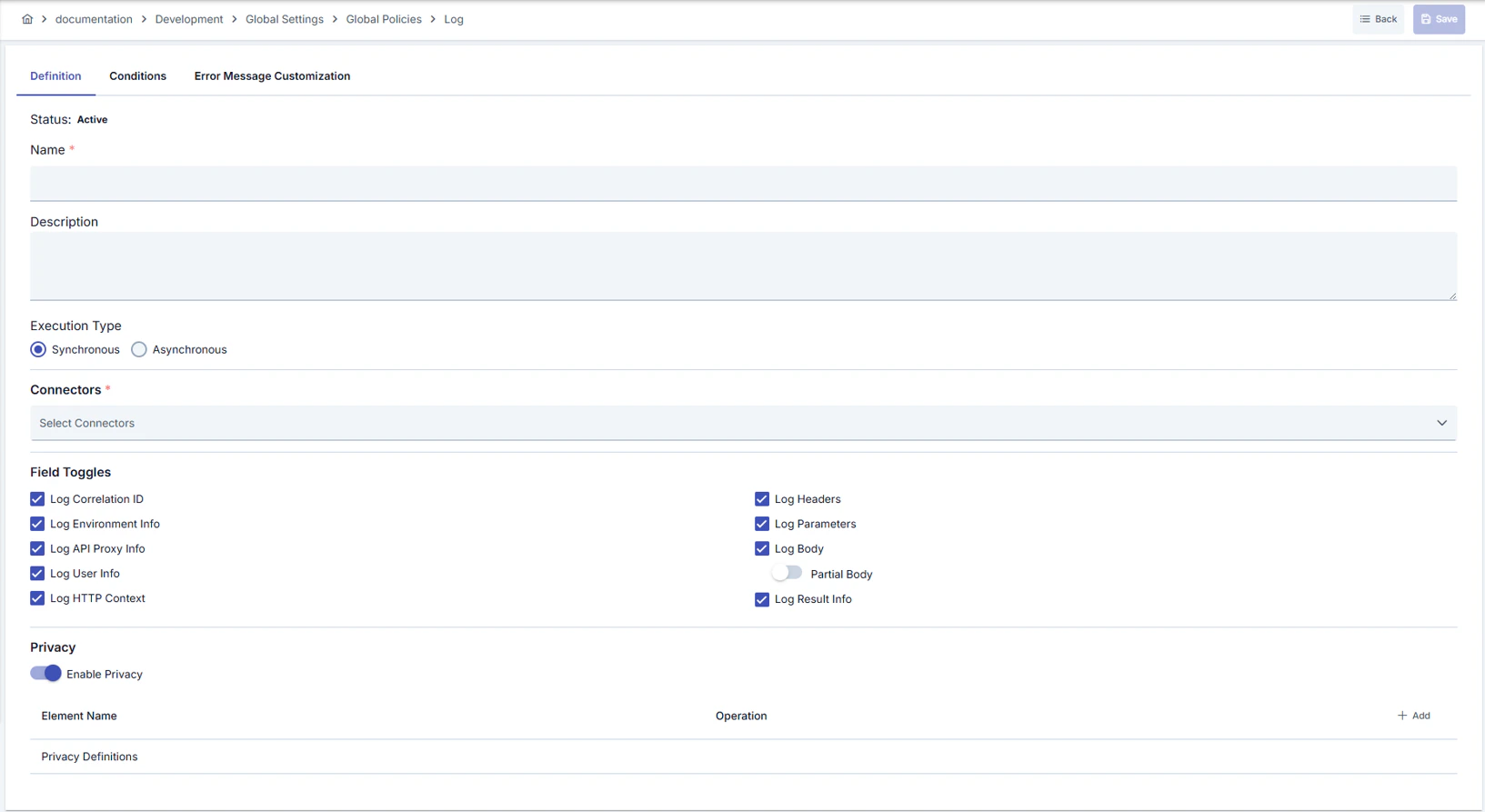
General Settings
Connector Selection
You can select the connectors to which the policy will send logs. Connectors are selected through connection definitions and work independently of environments — the same connection definition may correspond to different connector instances in different environments.
A log policy defined as a global policy works across all environments. In each environment, the connector corresponding to the relevant connection definition is automatically matched.
Logged Fields
You can determine which of the following field groups are included in the log record:Body Logging Mode
Privacy Settings

Privacy settings are applied at two levels: first the policy-level settings, then the connector-level settings. If both levels are enabled, both are applied in sequence.
Sync and Async Execution
Use Cases
Related Pages
- Message Flow and Policy Management
- API Proxy Traffic Log Settings
- Connectors
- Adding Connectors to Gateway Environments
Next Steps
Script Policy
Custom data transformation with scripts
API Call Policy
External API calls within the pipeline