

Client Route Features
Overview: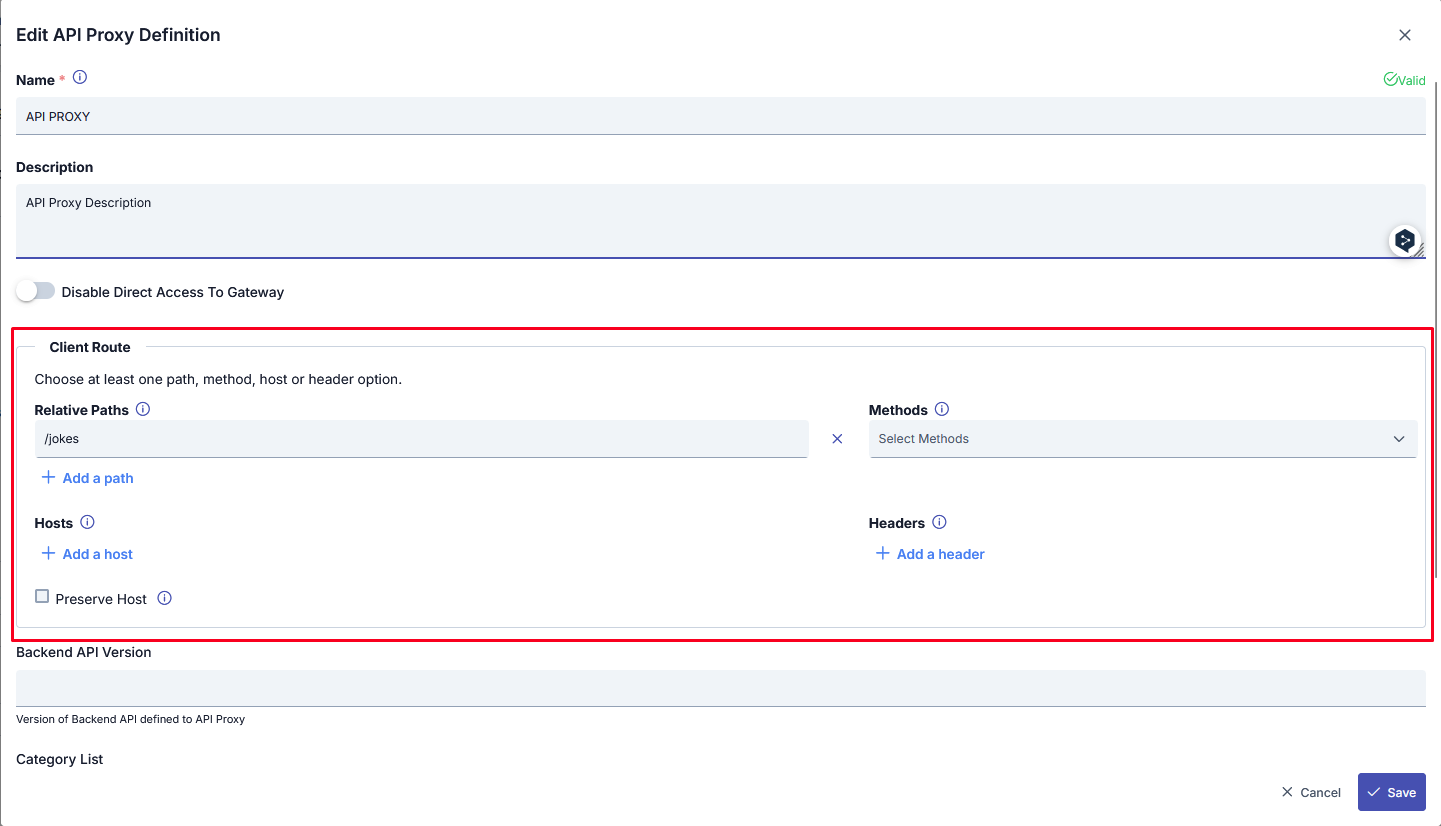
Multiple Paths
You can define multiple relative paths for an API Proxy
Host-Based Routing
You can route to different API Proxies based on host information
Header-Based Routing
You can create routing rules based on HTTP header values
Method-Based Routing
You can perform HTTP method-based routing
Before this feature was developed, only a single unique relative path could be defined for each API Proxy. With the new feature, multiple API Proxies with the same relative path can be created, and dynamic routing can be performed between them based on host, header, or method information.
Routing Priority Order
The Gateway evaluates incoming requests according to the following priority order:1. Relative Path
Highest priority
2. Hosts
Host header check
3. Headers
Header check
4. Methods
Lowest priority
Matching Logic
Hosts (OR Logic)
When multiple hosts are defined, it works with OR logic. That is, matching any one of the defined hosts is sufficient. Example:hostname_x.com or hostname_y.com, the condition is met.
Headers (AND Logic)
When multiple headers are defined, it works with AND logic. That is, all defined headers must match. Example:testmode: true and test: true headers must be present in the request.
Path Matching
- Relative path matching has the highest priority
- More specific (longer) paths are evaluated before more general (shorter) paths
- If an exact match is not found, the closest parent path is used
Method Matching
- Method checking has the lowest priority
- If not specified, all HTTP methods are accepted
Wildcard Hostname Usage
Apinizer supports wildcard (joker character) usage to provide flexibility in host definitions. Wildcard hostnames allow all Host header values that match a certain pattern to satisfy the condition and thus match the related Route.Wildcard Rules
Wildcard Examples
Left-Side Wildcard
- a.example.com
- x.y.example.com
- api.example.com
- test.subdomain.example.com
Right-Side Wildcard
- example.com
- example.org
- example.net
- example.io
Example Scenario
The table below shows 5 different API Proxies and the Client Route configurations defined for them:Routing Examples
According to this configuration, incoming requests are routed as follows:Example 1: Basic Routing
Example 1: Basic Routing
Request:Result: Routed to Proxy 5 (default proxy since no condition is met)
Example 2: Host-Based Routing
Example 2: Host-Based Routing
Request:Result: Routed to Proxy 2 (host condition met)
Example 3: Routing with Missing Header
Example 3: Routing with Missing Header
Request:Result: Routed to Proxy 5 (Proxy 1 requires both headers, only one is provided)
Example 4: Full Header Match
Example 4: Full Header Match
Request:Result: Routed to Proxy 1 (all header conditions met)
Example 5: Path Priority - Basic Path
Example 5: Path Priority - Basic Path
Request:Result: Routed to Proxy 4 (exact path match)
Example 6: Path Priority - Long Path
Example 6: Path Priority - Long Path
Request:Result: Routed to Proxy 3 (more specific path takes priority)
Example 7: Path with Sub-Path
Example 7: Path with Sub-Path
Request:Result: Routed to Proxy 3 (closest parent path match)
Example 8: Path Match - Different Sub-Path
Example 8: Path Match - Different Sub-Path
Request:Result: Routed to Proxy 4 (matched /jokes1 as parent path)
Example 9: Host and Header Combination
Example 9: Host and Header Combination
Request:Result: Routed to Proxy 2 (host has higher priority than header)
Example 10: Different Path with Host and Header
Example 10: Different Path with Host and Header
Request:Result: Routed to Proxy 4 (path has highest priority, host and headers are ignored)
Routing Combination Table
This table shows from the API Proxy perspective how the API Proxy is selected:
The table below shows how the API Proxy is selected in different combinations:
Important Notes
Path Matching
Path Matching
- Relative path matching has the highest priority
- More specific (longer) paths are evaluated before more general (shorter) paths
- If an exact match is not found, the closest parent path is used
Host Matching
Host Matching
- Multiple hosts can be defined
- Hosts work with OR logic
- If the host value in the request matches any of the defined hosts, the condition is met
Header Matching
Header Matching
- Multiple headers can be defined
- Headers work with AND logic
- All headers defined in the request must be present
- In case of missing or incorrect headers, it moves to the next suitable proxy
Method Matching
Method Matching
- Method checking has the lowest priority
- If not specified, all HTTP methods are accepted
The Client Route feature allows you to easily manage complex routing scenarios in your API Gateway. By understanding the priority order and matching logic correctly, you can create flexible and powerful API routing configurations.
Related Pages
Client Route
Learn about Client Route concept
API Proxy Creation
API Proxy creation
Routing and Upstream
Learn about Routing and Upstream concepts
HTTP Routing
HTTP Routing configuration
API Proxy Configuration
API Proxy settings