

Overview
What is its Purpose?
- Encryption policy increases data transmission and storage security by encrypting sensitive data in API Proxy (API Proxy Server) flow with standard algorithms.
- Writes data from source variables to target variables in encrypted form and prevents access to unmasked data.
- Provides consistent security configuration by centralizing secret key and certificate management.
- Encryption is applied only when specified endpoint or header criteria are met through condition-based activation.
Working Principle
- Request Arrival: For each HTTP/HTTPS request arriving at the API Gateway, the source IP address of the request is identified.
- Policy Check: If the Encryption policy is active, the system checks in the following order:
- Is a Condition defined? If so, is the condition met?
- Is the policy active (active=true)?
- Is a Variable used or is Apinizer default?
- Execution of Encryption Definitions: For each
policyEncryptionDefentry, source variable is read, encryption is applied with selected algorithm and key/certificate, result is stored in target variable, and IV and algorithm information are written to relevant variables if necessary. - Decision Making:
- Match Found: All definitions are processed successfully, flow is routed to next policy or endpoint.
- No Match: Policy is skipped when condition is not met, no changes are made to data.
- Error Handling: Customizable HTTP status code and error message are returned for requests that do not comply with the policy rule.
Features and Capabilities
Basic Features
- Multiple Encryption Step Management: Separate algorithm and target variables are defined for different data fields by creating multiple encryption definitions in a single policy.
- Algorithm Flexibility: Different mode and padding options such as AES, DES, Triple DES, and RSA are supported; dynamic selection can be made at runtime with algorithm variable.
- Key/Certificate Integration: Secret keys are selected from
Crypto Key Infoentities and certificates fromCertificatemanagement, integrating with centralized secret management system. - Active/Passive Status Control: Easily change the active or passive status of the policy (active/passive toggle). In passive state, the policy is not applied but its configuration is preserved.
- Condition-Based Application: Determine when the policy will be applied by creating complex conditions with Query Builder (e.g., only for specific endpoints or header values).
Advanced Features
- IV Management: IV generation or retrieval from external variable is provided for algorithms requiring IV, IV format is determined as BASE64 or HEX.
- Variable Update Dialogs: Selection of correct variables is facilitated with separate dynamic selection windows for source, target, algorithm, and IV variables.
- Localization and Global Mode: Global policies can be converted to local copies; local policies can be added to global repository for centralized management.
- Export/Import Feature: Export policy configuration as a ZIP file. Import to different environments (Development, Test, Production). Version control and backup capability.
- Policy Group and Proxy Group Support: Manage multiple policies within Policy Group. Bulk policy assignment to Proxy Groups. Centralized update and deployment operations.
- Deploy and Versioning: Deploy policy changes to live environment. See which API Proxies use it (Policy Usage). Proxy Group and Policy Group usage reports.
Usage Scenarios
Configuring Policy Parameters
At this step, users can create a new policy or configure existing policy parameters to define access rules. The defined parameters directly affect how the policy works (e.g., which IPs will be allowed, geographical restrictions, conditional activations, etc.). This way, the policy can be customized according to organization-specific requirements and managed centrally.Creating a New Encryption Policy
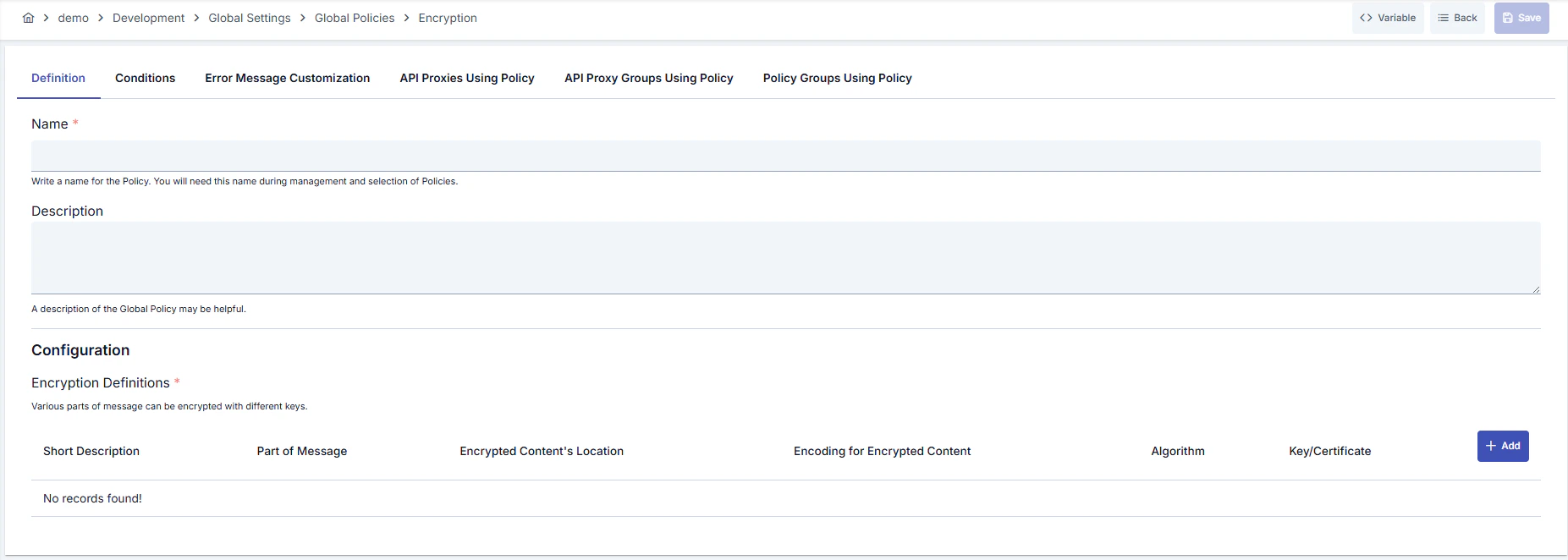
Configuration Steps
For the description of Conditions and Error Message Customization panels, you can review the Conditions and Error Message Customization sections on the What is Policy? page.
For a complete guide on all layers, priority order and scenario examples of the error message configuration system, see the Error Message Configuration Guide page.