


Role Definition
The only value required for defining roles is the role name value.Roles can be unique throughout Apinizer.
Roles defined within a project only appear within the project.

Using Role Based Access Control in Policies
Apinizer authorization structure is not used as a separate policy, but together with an “Authentication” policy. It is added to all appropriate authentication policies in the same way.Authorization allows putting one more level of security layer after authentication control. The roles that the authenticated user has are compared with the roles expected by the method/endpoint to be accessed.
- If the roles the user has do not meet the roles expected by the method/endpoint, the message flow is interrupted and an error is returned.
- If the roles the user has meet the roles expected by the method/endpoint, the message continues its path.
Authorization Settings
Authorization settings are made in the “Authorization Configuration” section of the authentication policy. First, authorization settings must be activated in this section. When authorization settings are activated;- If the policy is added to an API Proxy, role-based access control can be defined both on an API Proxy basis and on the method/endpoints of the API Proxy.
- If the policy is added to an API Proxy Group, role-based access control can only be defined on an API Proxy Group basis.
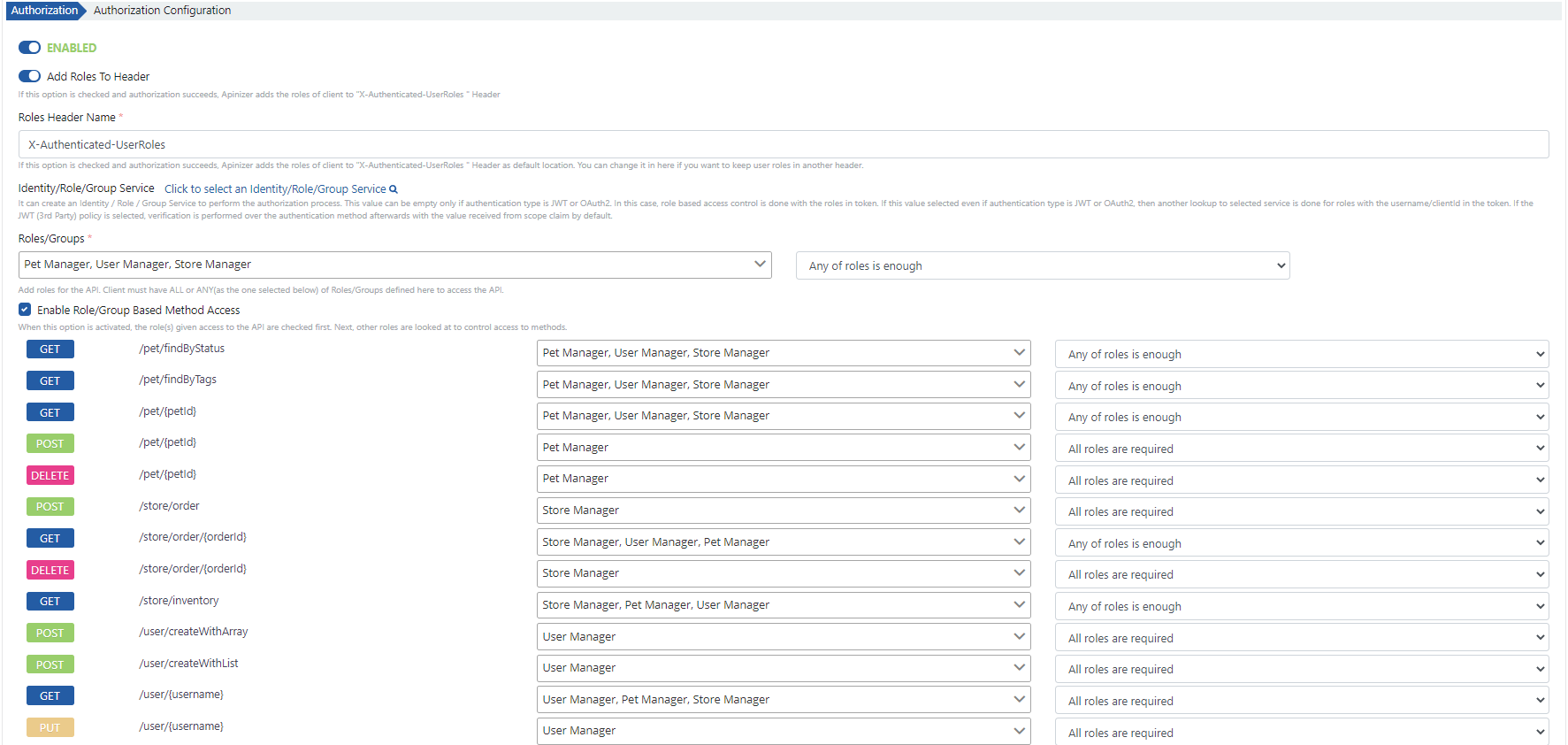
For detailed information about role definitions, you can visit the Credential Roles
and Identity Providers (Identity Providers)
pages.